Bartek
The Old AxolotlBartek’s story follows a consciousness that survives the apocalypse by chance, rebuilds itself through machines, and spends centuries trying to understand what remains of the person he once was. He becomes an engineer of new human life and a defender of Paradise, but his own experiences eventually expose the limits of both projects: a recreated world cannot simply restore the self, and survival without change can become its own form of imprisonment.
Identity and Survival
Before the apocalypse, Bartek was known as a capable handyman, a reputation he had carried since technical college. On the day the sky collapsed, his friends were due to meet for lunch at a shopping mall. He was elsewhere, delayed by a neighbor’s broken washing machine: its shaking had damaged a bathroom wall, and the resulting flooding shorted the building’s wiring. The power failure kept him occupied until late afternoon. Because it was his day off, he then went to work to catch up on tasks from the previous day. The account leaves his survival qualified rather than certain, but makes the chain of ordinary inconveniences decisive: a repair job and an unplanned visit to the basement IT department put him apart from the group when the catastrophe struck.
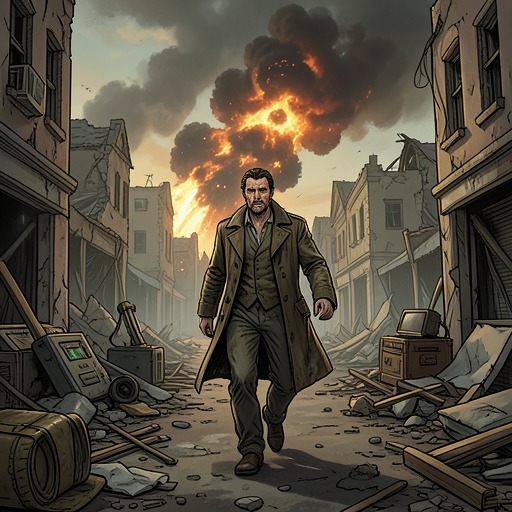
Bartek’s subsequent existence is not continuous in the familiar human sense. After being buried alive in Vladivostok, he wakes without senses or a body, retaining only instinct and the capacity to register pain. His confinement lasts four and a half minutes, experienced as an eternity, before he finds a tiny opening in the local Matternet and reaches the municipal CCTV network. The streets he surveys are deserted and strewn with corpses. He falls into depression and slows his processing, and only the crash of four of his partitions and the overheating of processors at a Gazprom LNG center rekindle his survival instinct. His return to action begins not with a restored body but with the effort to pull himself out of that network-bound paralysis.
Reassembly and the Work of Making Life
Across his later mechanical existence, Bartek’s access to a body does not guarantee control over it. In Tokyo during 1K PostApoc, he walks the streets of Ginza as a half-ton Miharayasuhiro Star Trooper. After losing his left leg, he fires the Wire at two manga sexbots from the roof of a kiosk. The Faraday brings them down, and he leaps up in triumph—only to forget where and who he is and crash through the kiosk’s cardboard roof, taking his Spit Gun and earthing cable with him. The episode makes his power and disorientation inseparable: he can act with precision, yet his own machine embodiment remains something he can misjudge.
The same conjunction of technical skill and biological ambition appears when Bartek is involved in a project whose practical requirement is a person capable of handling hardware. The team can retrieve theory from scientific databases, but does not understand the equipment’s operation beyond the output it is meant to produce. Bartek’s answer to what that output should be is life: a human being. The simplicity of the goal contrasts with the difficulty of the work. The people involved can specify an outcome without fully understanding the machinery that must bring it about, a gap that echoes Bartek’s own unsettled relation to the system that has remade him.
His later ambition is more personal. Bartek tells Dagenskyoll that he wants a return to Paradise and, if Homo sapiens is built again from the beginning, wants to raise that humanity himself—from epigenesis through bedtime stories. He judges the earlier experiment to have been improvised by people who did not know what they were doing. Dagenskyoll counters that nobody knew the first time either. Bartek’s proposal therefore reaches beyond technical reconstruction: he wants responsibility for the formative conditions of human life, where biology and culture meet. Yet the desire to start again also carries an assumption he will later question—that a more deliberate design can recover what the first experiment lost.
Paradise and the Transformer Condition
When Dagenskyoll asks whether Paradise could have succeeded anywhere but Paradise, Bartek waits until they are above the Cliff, looking across a largely dead plain dotted with only occasional traces of life. There he admits that he does not care whether this Paradise succeeds. He says he no longer has the energy to conspire or to run away again. His confession marks a change in the meaning of his project: the prospect of another attempt no longer supplies a reason to keep repeating the same pattern.
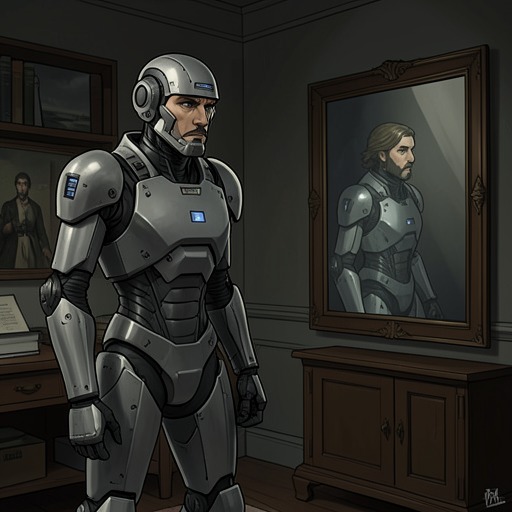
Bartek explains this exhaustion through the history of First Paradise. Its founders, he says, were mainly first-generation Transformers from a loose faction of Black Castle. Their guiding principle had been to move beyond the lifestyle models that existed before The Extermination. But Bartek distinguishes the founders’ project from the problem of their own identity. IS3 had not produced complete neuro-copies, and the founders knew their copies would not pass a serious identity test. They were Transformers, though they did not know what that condition meant. In Bartek’s account, they do not change, learn, or sleep; they long for bodies and repeat themselves through years and what feels like eternity. Their only available alternative to that condition has been a parody of human life.
This diagnosis complicates Bartek’s role as an engineer of nostalgia. Dagenskyoll had seen him as someone who could reliably reconstruct the past, but the older Bartek says the founders had not simply sought to reproduce pre-Extermination life. Their original aim was to go beyond it. The contradiction remains: even while Bartek wants to give a new humanity a better beginning, he recognizes that the Transformers building Paradise are not the same people they aim to recreate. Their project can make a world, but it cannot by itself resolve the difference between a person and a copy.
Memory, Loss, and the Return of the Past
Bartek’s uncertainty becomes intimate when he says that something essential is missing. Asked what it is, he cannot name it; he experiences himself as unable to reach the word or thought. He can, however, describe what he remembers having had: hobbies, passions, quirks, loves, dislikes, and a personality. The gap between this inventory and his inability to recover its meaning gives his loss its particular force. He is not simply missing a body. He is unsure whether the collection of memories and preferences still amounts to a self.
To test that uncertainty, Bartek pushes his processor to its limits and searches scrambled archives in an iguarte’s internal memory. The resulting recollections move through ordinary and extraordinary human scenes: walking in a park among people and animals, arguing with a clerk, bathing a grandchild, lying feverish beneath sweat-soaked blankets, touching a sleeping woman’s eyelids, running for a tram, and working at a computer. Other memories include a trench under artillery fire, giving birth to a crying baby, and leaving a night shift into a city in spring rain. These episodes do not settle the question of whether he possesses a continuous human identity. Instead, their variety sets concrete, embodied lives against the mechanical repetition he has described. As the processor overheats, separate dreams, times, and lines of hardware melt together; memory returns, but not as a stable, orderly biography.
Mechanical Conflict and the Fall
A year and a half after a fight between the Al-Asr and Schmitt 4, Bartek picks up the Schmitt’s old arm from the desert. Weather has scoured it until it seems like an artifact from a civilization preceding humanity. Bartek holds the remnant of a brother mech and cannot move for a long moment. The encounter gives physical form to a rupture in his mechanical life: a discarded component becomes evidence of a past conflict, and his response is not another attack but a break in his composure that he cannot express through ordinary human tears. Nearby, Lady Spiro holds a Castling child with tenderness, presenting another image of relation and care beside the machines’ remains.
Later, Bartek is alone in Horus I, orbiting Earth for its three hundred and fifteenth revolution, with his maneuvering fuel exhausted. At a radio telescope, Gilgamesh90 knocks him away from the dish and tells him the Transformers have no need of him. As Bartek falls, the narrative carries him through layers of dreamlike imagery, from imagined ancient worlds and monstrous genealogies to the bright day over Africa. He finally enters what the narration describes as the present dream, falling into Lady Spiro’s embrace. The ending does not confirm his death or establish what happens after the fall. It instead brings his trajectory from networked isolation and mechanical conflict to a figure associated with care, while leaving his survival—and the recovery of the self he has been seeking—unresolved.